
Keys to Unlock the Metro
Written by Ben Helvick Anderson, Vice President of Policy and Organizing
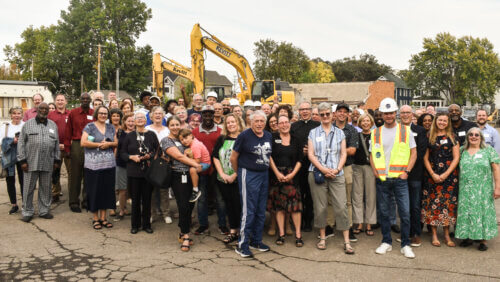
On Wednesday, June 14, dozens of clergy and people of faith processed from Central Presbyterian Church in downtown St. Paul to the Met Council Chambers. In front of the full Met Council members, Pr. Elijah McDavid from Fellowship Missionary Baptist presented hundreds of keys collected by congregation members.
“These keys represent the 1,900 affordable homes that need to be built every year – Met Council, unlock these homes!” he proclaimed to the Council.
The clergy and people of faith were there as part of the Unlock the Metro campaign, Beacon’s effort to generate more resources to create more deeply affordable homes in the suburbs. One of the key problems in the state’s housing crisis is the lack of deeply affordable homes available to those at or below 30% of the Area Median Income (AMI).
Nowhere is this shortage starker than in the suburbs of the Twin Cities. The lack of 30% AMI housing in suburban communities disproportionately impacts Black, Indigenous, and other minority households. In its 2040 plan, the Met Council centers equity as a fundamental value, but according to its reports, the Twin Cities metro has some of the worst housing disparities in the nation.
According to the Met Council data available, only 218 deeply affordable homes have been built in the suburban Metro since 2016, while the Met Council’s goals project we need over a thousand a year. Beacon created 49 of those 218 homes, and our mission and values call us to go where the need is greatest and step this up. Our new strategic plan directs us to build half of our new homes in the suburbs. We currently have 170 new suburban homes in production that could all be deeply affordable if we were awarded project-based vouchers through the open Request For Proposal done by the Metro Housing and Redevelopment Authority (HRA), a department of the Met Council in charge of vouchers.
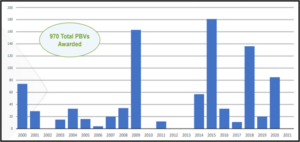
Beacon currently operates or has been awarded 109 of the Metro HRA’s project-based vouchers, about 11% of their total project-based vouchers. We believe that Metro HRA is not set up to reach its full potential, which has prevented Beacon and other developers from building more deeply affordable homes. It inconsistently awards vouchers year-to-year and creates no clarity or transparency for developers. Some years no project-based vouchers are awarded, and the service area for vouchers recently changed. None of this encourages development. For the last two years, we have raised these concerns with staff through the channels created for feedback.
Metro HRA’s PBV Offer and Award History (2000-2021)
Beacon’s Unlock the Metro campaign believes the Met Council, as the governing board of the Metro HRA, has an opportunity to develop a policy to better utilize project-based vouchers to spur development in the suburbs. Beacon cannot produce all of the deeply affordable housing needed, and for other developers to join in creating more homes, the Metro HRA needs a clear policy to draw them in.
A policy in the upcoming annual plan for the Metro HRA could:
- Create a goal for the Metro HRA to grow the development of deeply affordable housing in the suburbs by allocating project-based vouchers.
- Allocate vouchers annually in a clear, dependable way that coordinates with the Minnesota capital funding awards.
- Make Metro HRA PBVs available across the 7-county metro region, as before.
With this policy, the Met Council could Unlock the Metro to deeply affordable housing created by Beacon and other developers. Such a policy would have to balance the needs of tenant-based vouchers in the region and the required staff time to deploy and operate the project-based vouchers. Beacon hopes to be a continued partner with Metro HRA staff to balance these competing priorities.
While the issue is complex, we know the shared values are simple. We all want more homes and, as Pr. Elijah said to the council:
“I ask you to make a policy this year on project-based vouchers connected to development goals and to award them across the metro, for the sake of human dignity and communal diversity.”