Housing Smarter: Renewable Energy Use Expands Across Beacon’s Portfolio
For the past several years, quiet progress has taken shape across Beacon’s buildings on rooftops and in contracts signed with community solar developers. It is not so much a secret as a slow build: one property at a time, one relationship at a time, always alongside our core work of developing and operating affordable, supportive, and stable homes.
Beacon’s solar initiatives have now reached a scale worth talking about.
Where things stand
By early 2027:
- Nearly 7 in 10 homes in the Beacon portfolio will rely partially or entirely on solar energy.
- 17 separate solar arrangements will be in place — a mix of owned arrays, power purchase agreements, and community solar subscriptions.
- Together, these arrangements will include nearly 2 megawatts of renewable energy capacity, equivalent to the needs of about 400 homes.
- The result: more than $160,000 in annual savings, divided between lower operating expenses and lower utility bills for residents who subscribe to community solar.
We’re not done! We have plans next year to add solar to at least three more properties and continue to evaluate all of our sites. We will continue to seek out opportunities to improve our operating efficiency and reduce residents’ electric bills through renewable energy development alongside our core work.
Why this matters for the mission
Operating expenses of affordable housing escalate over time. Costs (insurance, utilities, maintenance, and staffing) continue to increase. This often lands hardest on the properties that serve people with the lowest incomes. Every dollar going to a utility bill is a dollar that cannot be used for other building and staffing needs.
Solar renewable energy changes the math in a durable way. Power purchase agreements with TruNorth, for example, lock in a flat rate per kilowatt-hour for ten years which provides a level of budget certainty hard to find elsewhere in a property operating budget.
Beacon’s pursuit of solar responds to a key question we always ask ourselves: how can we operate our buildings better, for longer, so our homes stay stable, high-quality, and affordable for our residents? Renewable energy provides one clean answer to this question. Kevin Walker, Vice President of Housing Development, who has driven Beacon solar initiatives asks, “Why settle for electricity from the grid when we can do so much better, for our residents, Beacon, and the community?”
What it means for residents
Through our rooftop arrangements with Cooperative Energy Futures (CEF), residents subscribe directly to solar generated on the buildings where they live and see savings in their monthly energy costs. For households making tough choices about how to use limited resources, it reduces the cost burden of energy, leaving more for groceries, medicine, transportation, and everything else.
Since CEF is a cooperative, its subscribers (including Beacon and subscribing residents) are eligible for dividends when available on top of electric savings. These savings, whether going directly to residents or the property, support a higher quality of life for residents. A property with predictable, lower operating costs is a property that can be better maintained and staffed. All else being equal, that’s a better place to live.
How it works in practice
Beacon uses multiple approaches to accessing solar energy:
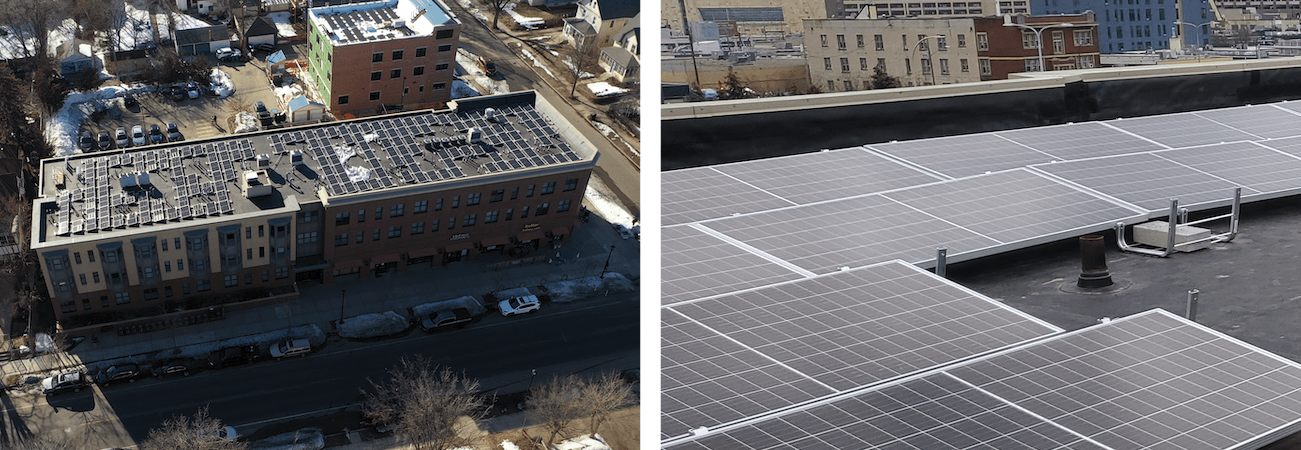
- Owned arrays. Great River Landing has its own rooftop solar array, directly reducing the building needs for purchased energy.
- Power purchase agreements. Long-term contracts, like our ten-year, fixed-rate agreements with TruNorth, supply a portion of a property’s power in an onsite rooftop array initially owned by our solar installer at a negotiated discount price. Vista 44 and 66 West are examples.
- Community solar subscriptions.
- In community solar arrangements, Beacon properties or residents subscribe to onsite rooftop or offsite community solar gardens. Beacon has both onsite and offsite community solar arrangements with CEF. Lydia Apartments subscribes to a CEF community solar array above Ramp A adjacent to Target Field in downtown Minneapolis.
- In Beacon’s newest arrangement, US Solar, a Minneapolis company, will develop four ground-mounted community solar gardens in outstate Minnesota that include native plantings. These will soon serve nine Beacon properties. The US Solar arrangement will supplement both properties already partially served by rooftop solar and ones not suited for onsite generation.
A form of stewardship
Beacon’s mission calls us to be good neighbors and good stewards of the homes we build, the resources our supporters entrust to us, and the communities where we work. This solar work is a small, practical piece of that. It uses energy produced here in Minnesota on solar arrays installed by local work crews. It strengthens our ability to keep properties in good repair for the long haul. It puts money back in residents’ pockets. It does all this without asking anyone to choose between affordability and doing things well.
For Beacon, that is what housing smarter looks like.