Finding Home
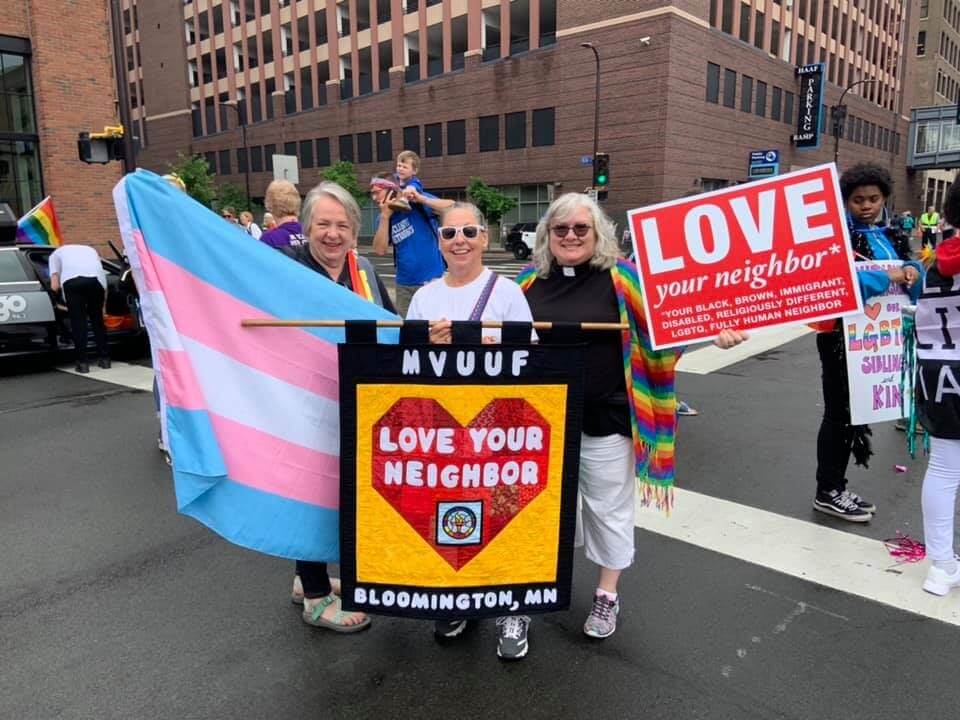
Written by Rev. Laura Thompson, Minnesota Valley Unitarian Universalist Fellowship in Bloomington
I left home in 1985, shortly after my 17th birthday. Though today my family is accepting and proud of me, things were different back then. I had come out a year earlier. My parents didn’t condemn me or kick me out, but it was tense. LGBTQ youth often have a hard time feeling like they belong at home, at school, in society… I was no exception and it was part of the reason I left home before graduating high school. I spent the next few years experiencing housing insecurity; I bounced around various friends’ houses, lived in a Loring Park efficiency apartment with 4 – 5 other LGBTQ teens roaming in and out, and stayed at a woman’s shelter for a while. My story is not uncommon.
Some studies show upwards of 40% of homeless youth identify as LGBTQ [1]. But, it’s not just youth that experience higher rates of homelessness and housing insecurity; 33 % of the LGBTQ population live in states that do not prohibit housing discrimination based on sexual orientation or gender identity [2]. Of course laws don’t mean that folks in the other states don’t experience housing discrimination, because they do.
A 2013 study by the U.S. Department of Housing and Urban Development showed that same-sex couples experience significant levels of discrimination when responding to advertised rental housing in metropolitan areas nationwide. In this study, heterosexual couples were favored over same-sex couples by sixteen percent. For transgender people, housing discrimination is even more prevalent. According to the 2015 U.S. Transgender Survey, nearly one quarter of transgender people report having experienced housing discrimination within the past year because of their gender identity [3].
The housing problem doesn’t end with age either. It is estimated that there will be 7 million LGBTQ elders living in this country by 2030. Recent studies showed that 48% of older same-sex couples experienced some form of housing discrimination [4]. LGBTQ elders often don’t have the same family structures of support as their non-LGBTQ counterparts. They are at higher risk of having less income or savings in their later years due to employment discrimination throughout their lives. Senior living facilities are not often explicitly friendly and welcoming to LGBTQ folks, so once again we are left feeling like we don’t fit in.
It’s worth noting, in any of these situations, that Trans folks experience discrimination in higher numbers. Intersectional identities of being BIPOC, disabled or an immigrant also increase the risk of homelessness, housing insecurity and affordable/available housing for LGBTQ people. As we spend the summer months celebrating LGBTQ PRIDE, let us not forget that housing is also an LGBTQ issue.
There are lots of things to do to continue to address the problem. First and foremost, we can all keep creating a safer culture for LGBTQ folks, in general, by making sure they feel welcome in our schools, work places, congregations and in our very own families and homes. This work needs to be explicit. Church signs and welcoming words need to say that we are welcome. LGBTQ support systems in schools need to be in the forefront. Housing agents, apartment communities and senior living facilities need to do the work of undoing their own biases alongside explicitly creating a welcoming culture for LGBTQ folks.
It’s important that all of this work be done explicitly and outwardly, so that the LGBTQ can see and hear it, because our default experience is often that spaces are not welcoming toward us unless we are told otherwise. Being explicit in saying that you are a welcoming space not only lets LGBTQ folks know that it is a safe space, but it lets non-LGBTQ folks know that they are expected to be a part of creating that welcoming and safe space for us. In doing this work together, we can build communities where everyone has a safe and welcoming place to call home.
Links and resources:
[1] https://www.opportunityhome.org/resources/lgbtq-rights-and-housing-fact-sheet/
[2] https://www.lgbtmap.org/equality-maps/non_discrimination_laws
[3] https://www.hrc.org/resources/fair-and-equal-housing-act
[4] https://www.sageusa.org/what-we-do/national-lgbt-housing-initiative/