
State Policy Change Hopes to Reduce Barriers for Those Exiting Homelessness
A recent change in state policy hopes to reduce some of the barriers that people face in exiting homelessness.
Written by Davis Parker, Public Grant/Program Evaluation Coordinator
I recently had to renew my driver’s license. It involved reading technical pages of size six font to determine which documents I needed, and then finding them – a certified birth certificate, several forms of address verification, my expired license, and a social security card. I pulled my birth certificate (you need one with a raised seal) and other documents out of the files in my home office. Then I took a couple of hours away from work to visit the government center and paid their $47.00 fee.
However, for many people seeking to exit homelessness, the requirements to have a birth certificate and valid photo ID are significant among many other barriers. An ID is needed to sign a lease, yet vital documents and forms of ID are often lost, inaccessible, or may never have been requested amidst the traumas and disruptions of experiencing homelessness.
The challenge of getting a birth certificate or other documents is especially difficult for youth who have experienced homelessness. One report found that 82% of youth entering supportive housing programs across Minnesota did not have an ID at the outset of the referral into housing. In Beacon’s youth housing, often one of the first steps when a youth is referred is to work with them to get their personal documents and ID.
During the COVID-19 pandemic, Beacon and other housing providers have seen an unfortunate increase in the amount of time it takes people to enter supportive housing. Missing birth certificates and state ID’s are part of this challenge. Getting these documents is harder when government offices are not open in person or have reduced capacity.
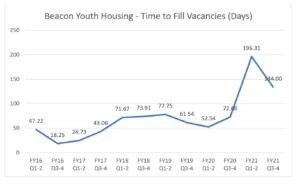 For example, in Beacon’s supportive housing for unaccompanied youth exiting homelessness – Nicollet Square, Prior Crossing, and 66 West – the average amount of time it would take to move in a new resident after a vacancy prior to COVID-19 was a bit under two months. Since the pandemic, it has taken over four months to move new residents in on average.
Pictured: A graph showing the time it takes to fill vacancies at Beacon youth housing.
As the housing crisis continues, it is challenging to have youth of any age experience homelessness for longer than is needed when safe homes are available.
Yet, starting this year a new Minnesota state policy went into effect thanks to a recommendation by several state agencies. Now, youth who qualify as homeless can option birth certificates and state IDs for no charge.
The new law allows for a service agency to complete an affidavit so youth can obtain their birth certificate and then an ID. The process to qualify for supportive housing is complex and at times daunting. Even this improved process for youth requires a multi-step process to obtain birth certificate, then ID, with various documents for each step.
While some youth are connected to outreach or drop-in services to assist them in this process and complete the affidavit, many youth are homeless and disconnected from services.
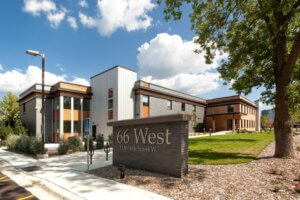 (Pictured: 66 West)
This improvement is welcomed by Beacon and our service partners serving youth – YouthLink, Simpson Housing, and the YMCA. We continue to seek further ways to streamline the intake process while meting our compliance requirements. To achieve Beacon’s vision that all people have a home, it should be easier for all people to access safe and deeply affordable housing. Policy changes like this are a welcomed step forward as we continue together in this important work.