
Reflecting on the power built for Bring it Home, Minnesota
Written by Nestor Gomez Jimenez, Campaign Manager
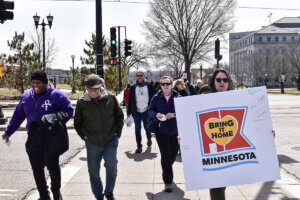 In the 2022 Legislative Session, the DFL House Caucus put forward a $1 billion plus spending plan for housing, which included $400 million for rental assistance (Bring it Home, Minnesota). This sent a motivating message to housing advocates across Minnesota who are organizing for policy change. It could have been a tremendous feat – if it passed.
While this plan built-up momentum and hope significantly, without enough support from the Republicans and Democrats in the legislature, as well as the will from Governor Tim Walz, the push for transformative change utilizing a historic surplus never seen before in Minnesota stalled.
We learned that work needed to be done before we could get closer to passing Bring it Home, Minnesota. We looked at ways to cultivate more extensive support for the campaign and analyzed what kept us from moving forward with efficiency and sharp aim. With a $12 billion surplus on our hands, we now understand that the greatest deterrent for us is the Governor’s lack of support, as he sets the tone for the legislature for the next four years and could sway the agenda of the legislature. Thus, we crafted a summer plan to move closer to our goal.
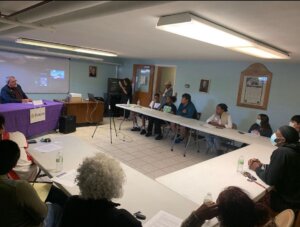
Our plan was simple: engage communities across Southern Minnesota, hold educational community conversations on housing with legislative candidates, and shine a light on the issues affecting those communities the most. We chose to conduct the conversations in four different communities. They included Worthington, Winona, Mankato, and New Prague.
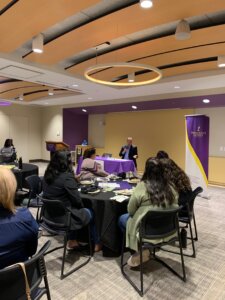
Each conversation brought out different issues and highlighted a real need for policy change in every legislative district that we organized in. Beacon teamed up with various organizations and institutions to hold these conversations and it was worth it.
Pictured: Meeting with Senator Bill Weber and House candidate Michael Heidelberger.
We heard from the people most impacted by housing inequities that there is a real need for policy change in the legislature. Among the issues that were raised the most included the need for rental assistance, increased support for mental health, increased housing-stock production, and increased creation of affordable and deeply affordable housing.
Our forums were created to be as fair as possible to enhance public dialogue on issues. While we attempted to host many more candidates for office, the candidates that showed up to our forums came from diverse political ideologies. They were:
- Sen. Bill Weber (Worthington)
- Candidate for House Michael Heidelberger (Worthington)
- Representative Gene Pelowski (Winona)
- Candidate for House Stephen Doerr (Winona)
- Senator Nick Frentz (Mankato)
Below you will find the election results for all the Senate and House districts we engaged in. Not all the candidates mentioned below were able to be present at our forums. The information below is to give you an idea of what kind of districts exist outside of the metro:
State District 21 (Worthington)
- Senator Bill Weber easily won his seat in the legislature with 97% of the vote
- For House Seat 21B (where we conducted our housing forum) Republican Marj Fogelman defeated DFL candidate Michael Heidelberger with 66.5% of the votes versus the latter 33.1%
State District 26 (Winona)
- Incumbent Republican Senator Jeremy Miller defeated challenger DFL-endorsed Daniel Wilson with 58.28% of the votes versus the latter 38.81%
- For House Seat 26A Incumbent DFL Representative Gene Pelowski Jr defeated Republican-endorsed Stephen James Doerr with 55.04% of the vote versus the latter 44.85%
State District 18 (Mankato)
- Incumbent DFL Senator Nick Frentz defeated challenger Republican Mark Wright with 57.78% of the vote versus the latter 42.10%
State District 22 (New Prague)
- Senator Rich Draheim was comfortably reelected into office with no challenger in Senate District 22 and received 96.87% of the votes
Source: The Office of the Minnesota Secretary of State
 One of the main candidates that we wanted to hear talk about Bring it Home, Minnesota was Senator Rich Draheim, the previous Senate Housing Committee Chairman. We unfortunately could not get a conversation started in New Prague; however, we are excited to continue working diligently to make sure that issues are raised in his district. Among the people that were most active in generating public discourse were the schoolteachers in Madelia, Minnesota. There was a DFL-endorsed candidate in House District 22A who was from Madelia, however, the race was firmly won by the Republican-endorsed with 69.04% of the vote versus the latter 30.88%.
The Bring it Home, Minnesota team is grateful to the organizations that were able to introduce us to people on the ground with direct lived experience or well-connected to those facing housing instability.
Pictured: Forum event at Mankato.
Thanks to the help of:
-Hispanic Advocacy and Community Empowerment through Research MN
-Seeds of Justice, St. Mary’s Church of Worthington, Winona First Congressional Church
-Minnesota State University, Mankato’s Multicultural Network
Because of them, we were able to engage over 100 people in the process – all from different educational and socio-economic backgrounds and life stories. Due to the heavy focus of Beacon and its allies in the Twin Cities, there were few strong connections to community leaders in those areas that we initially were able to form connections with. Thanks to the new norm of video conferencing meetings, we were able to get a lot more done without having to drive extensively. We did, however, drive to these cities to build more authentic connections with the community leaders.
Our organizing efforts in Southern Minnesota provided a refreshing take on housing. We were able to connect with organizations doing incredible work without many resources. We learned about the living conditions of BIPOC and immigrant workers in southern Minnesota and even about heart-wrenching working conditions some young immigrants face just to survive and put a roof over their heads.
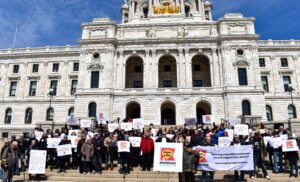 It was a phenomenal organizing effort from Beacon and all our allies this summer. We learned, connected, and shared intimate moments of struggle, and a reassurance that the work needs to continue to happen because people in positions of power in those communities are turning a blind eye to housing. We made many new connections, and we are happy to continue to work with them to make sure we help people most in need. We also must understand that rural communities need to be in conversation with us to help shape solutions.
We all do better when everyone has a place to call home. Housing instability is abundant in our state, and it is not a partisan issue. In the 2023 legislative session, it is needed to get involved in any way possible. There is a huge opportunity on the horizon and all of us need to take action to make sure housing is one of the top priorities of the legislature and we come up with solutions for everyone in the state, not just the Twin Cities.