
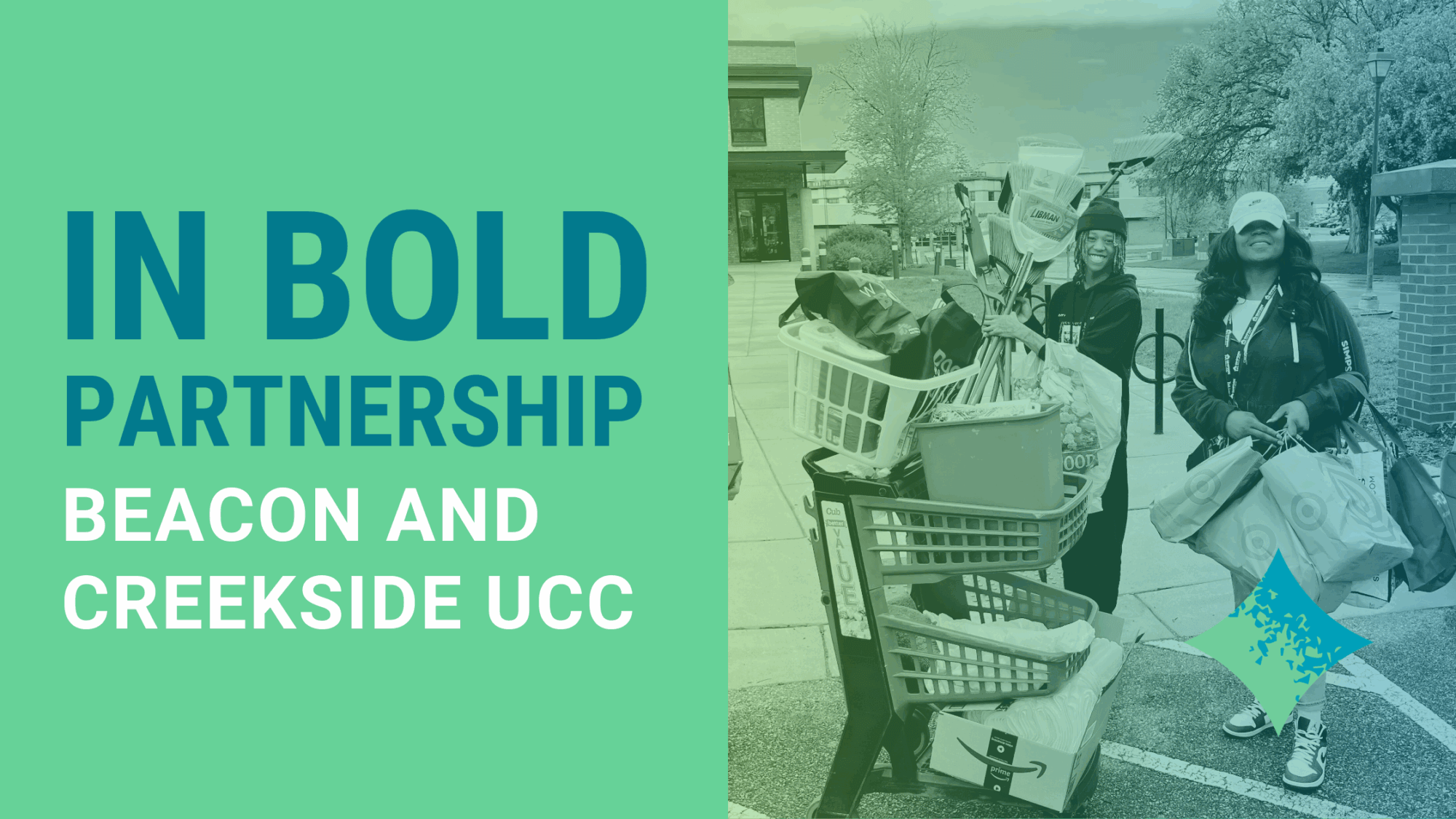
In Bold Partnership: Featuring Creekside UCC, a Beacon Collaborator
Creekside UCC, located in the Tangletown neighborhood of Minneapolis, has boldly walked beside Beacon since 2007 when together we committed to justice in action.
“They want to pull the biggest lever, they want to do the most impactful thing.” Rev. Emily Goldthwaite, Beacon’s director of congregational organizing, describes Creekside UCC as something of a powerhouse of justice work. “This congregation is at the top of those engaged in advocacy and organizing. For example, they sent the largest number of postcards to legislators during our federal work recently and regularly engage in the legislative session and local campaigns every year,” Emily adds.
A Legacy of Partnership
In the early 2000s, Creekside then known as Mayflower UCC, had two adjacent lots next to the church, one of which included a house that they used as emergency housing for recently arrived refugees. They started to think about what was next for the house, which was in need of repair. A dreaming session with the congregation took a big idea and made it even bigger—Beaconwas looking for partners to create more permanent supportive housing in the area.
After fierce neighborhood advocacy that was met with significant resistance, Creekside gifted the lots to Beacon, and Beacon’s first newly built apartment building, Creekside Commons, opened in 2010.
The “Why”
Rev. Emily was Associate Minister at Creekside during the years when residents moved in. The process of building relationships with the original residents of Creekside Commons led the congregants to understand precisely how the community they were building could best suit the needs of those they were welcoming. Many original residents were Muslim refugees from east Africa, often wary of whether Creekside would try to convert them.
Susan Lampe, Chair of Creekside’s Beacon Leadership Team, describes, “They came up with the idea that the children needed help with homework, because the parents weren’t speaking English all that well, but the young people were going to Minneapolis Public Schools. So, we started providing homework help. We did that for 10 years.” She continues, “As we built up relationships, those who were providing homework help developed relationships with the children, got to know them personally, and developed such momentum that we opened a Montessori preschool within our building that the children are invited to attend.”
Now, 15 years since Creekside Commons first welcomed residents, congregants work together to provide backpacks and school supplies to all the children each school year, and the relationship between the congregation and this supportive home for families is flourishing. Some resident parents even work at the Montessori preschool, too.
Rev. Emily Goldthwaite shares that observing Creekside’s process of making Creekside Commons a reality reinforced the congregation’s steadfast commitment to justice. She reflects on the time saying, “It felt risky, it felt hard to confront racism and NIMBYism along their own block. At the time they were very conscious that they were doing reparations work, racial justice work. They were confronting cultural and racial and class bias among their own neighbors and within themselves and their own congregation to make this happen. We’ve actually leaned into that much more explicitly in the years since then.”
Pulling the biggest lever
Creekside has a six-person team of congregation members that make up their Beacon Leadership Team, committed to maximizing their actions—they’re not acting on behalf of the congregation, they’re activating congregants. On the Beacon Leadership Team, Shelly Zuzek shares that her participation was precipitated by her longtime membership at Creekside UCC, plus a career in social work that led her to understand deeply the vital necessity of basic dignity of supportive housing.
Beyond the residents in their own backyard, Susan, as chair of this team, along with the other members, have recruited and activated six additional nearby congregations to support supply drives for Beacon’s 66 West building in Edina. “People have really stepped up,” Shelly shares. “I think that is because we are so visible through the newsletters and weekly updates, people know what we’re doing, and they understand what the need is. That’s a super tangible thing.”
Susie Hayward, Creekside’s Minister for Justice Organizing and Adult Faith Formation, says, “Being able to provide simple goods that can allow our neighbors to live with dignity is precisely in keeping with the command to love God and love your neighbor. It naturally flows that although you can grab these items easily, what it offers to our fellow Minneapolitans is the ability to live with dignity. Small things like that, to be able to wash your hair and go to a job interview looking like your best self, these are transformative powerful things.”
The Power of Collaborative Action
Susan emphasizes that participating in the Beacon Collaborative is not a single person operation. “You do need a team, a team of people who are also passionate and wanting to contribute. Everybody contributes—it’s a success because it’s a group effort,” she says.
Rev. Emily reinforces that Beacon’s work is necessarily and importantly magnified because it’s a group effort. Being part of the whole is really powerful, even if it’s a small group from a congregation, they know they’re being joined by others through Beacon’s wider Collaborative effort. Thus, the name: Beacon Interfaith Housing Collaborative.
Rev. Emily says, “I hear from our biggest congregations and our smallest—what it means to them to not be the only one. That if they tried it on their own, it wouldn’t be right or possible.” She adds that the collaborative impacts legislation because of its collective might, too, saying, “When our decision makers can see that that many of their constituents care about something, they make it a bigger priority and feel more accountable to explaining themselves. When many, many faith communities and clergy get involved in expressing the need, it also holds people accountable to values.”