Q&A with Jamey Flannery, Flannery Construction
Building Community Through Construction: A Q&A with Jamey Flannery, President of Flannery Construction
For decades, Flannery Construction has been building more than just structures—they’ve been building community. Founded in the late 1970s by Gerry Flannery and now led by his daughter, Jamey Flannery, the company is deeply rooted in the Twin Cities and focuses on mission-oriented development and affordable housing.
Beacon’s President and CEO Chris LaTondresse recently sat down with Jamey to discuss her journey in the family business, the importance of values-driven construction, and Flannery’s role in shaping projects like Kimball Court.
⸻
Chris LaTondresse: Jamey, welcome! To get us started, why don’t you introduce yourself and share about Flannery Construction’s journey and your role in the company?
Jamey Flannery: Thanks, Chris! My name is Jamey Flannery, and I’m the second-generation owner of Flannery Construction. The company was started by my father back in the late ‘70s and early ‘80s, initially renovating older homes in the Ramsey Hill area of St. Paul. My dad grew the company out of the back room of our house to Lowertown, and in 2005, we moved into our current building in the Midway area of St. Paul.
I grew up around construction—I knew all the carpenters, and people were constantly in and out of our house. It always felt like community to me. I went on to study Anthropology and Archaeology in college, which may sound like a leap, but I think it was a natural progression. Both are about understanding people and the spaces they inhabit. I eventually joined the business full time and have worked in nearly every role—from estimating and project management to operations.
⸻
Chris: Flannery Construction is unique among general contractors in its mission and civic-oriented approach. Why is that lens so important to you?
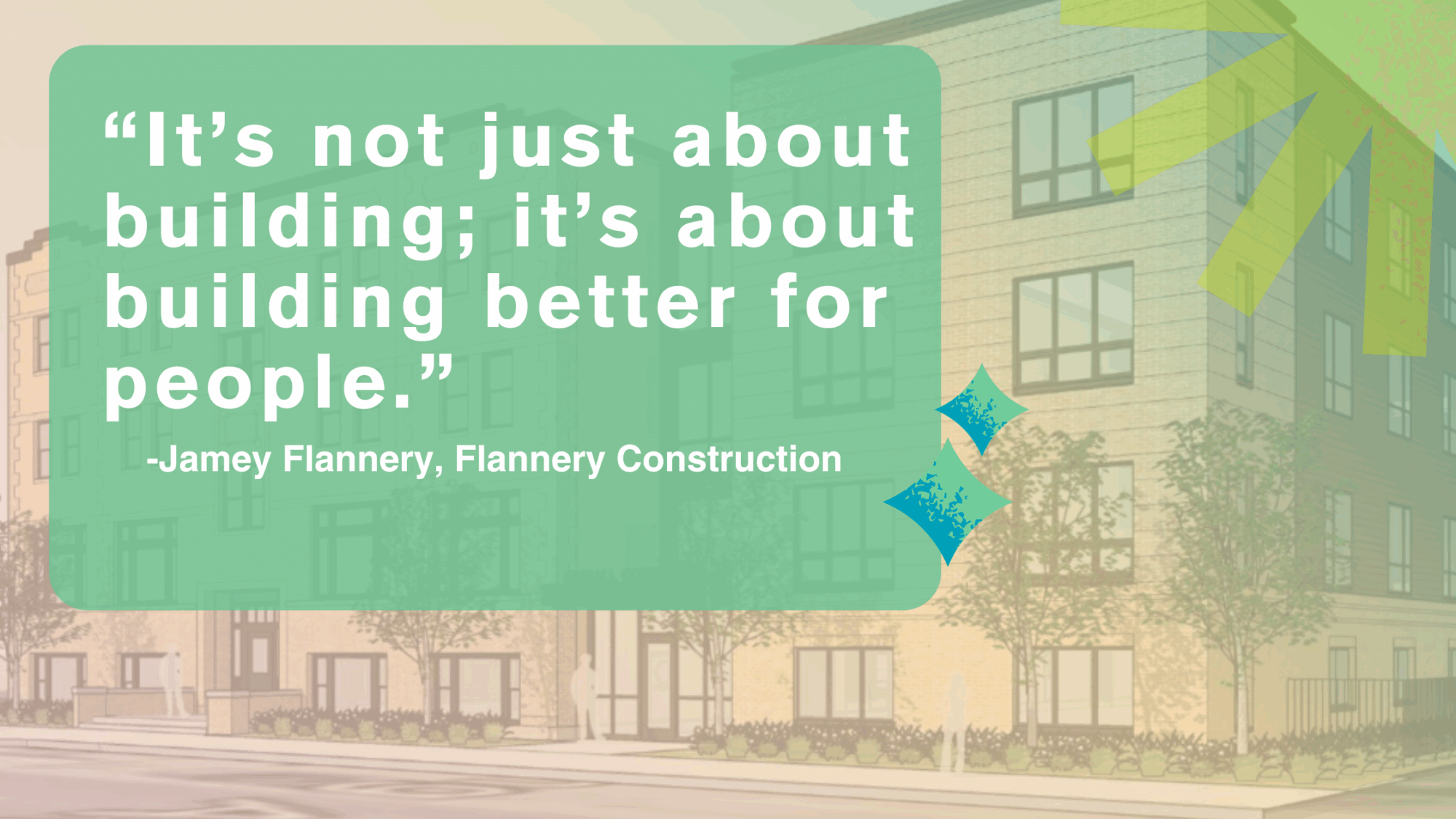
Jamey: Flannery Construction was founded on the values of civic-mindedness, quality, integrity, and diversity. My dad was kind of an old hippie—many of his friends were executive directors of nonprofits, so the company grew with this community-focused spirit. For me, it’s always been important that our workforce reflects the community we’re in. We use our construction skillset to make lasting, positive impacts. It’s not just about building; it’s about building better for people. I think we run our company differently than others—we lead with values and act on what we believe is right.
⸻
Chris: I love that. What are some tangible examples of how Flannery’s values show up in your work?
Jamey: One example is our commitment to our employees. We try to hire sustainably—we don’t just “hire and fire” based on project booms. We have employees who have been with us for over 30 years, which is rare in construction.
Another example is how we approach projects. We don’t charge for preconstruction work. We often spend three, four, even five years working on projects before they break ground, and we act as stewards, not just contractors. For example, in our work with Listening House—a day shelter serving people experiencing homelessness—we structured the project into three distinct phases to match their fundraising efforts and operational realities. We also provided detailed pricing options that broke out specific components of the project, helping their team present clear, compelling asks to donors and funders. This flexible and transparent approach allowed them to move forward without disruption to their services, while staying on track with their long-term goals.
It’s the right thing to do.
⸻
Chris: Those are powerful examples of values in action. Speaking of mission-driven work, let’s talk about Kimball Court. What excites you about Flannery’s role in that project?
Jamey: I think what’s most exciting is its complexity. It’s a super tight site that connects to an adjacent building with some structural challenges. It’s gritty and interesting from a construction perspective. But beyond that, Kimball Court is about solving real challenges for the community. Right now, the building is kind of porous—you don’t really know where to go, and it’s difficult to manage the building’s visitor flow. The renovations we’re doing will make it a more welcoming, controlled space with clear entry points and staff to help manage access. I really believe our expansion and renovation project will be a net positive for the neighborhood—not just the building, but for the community as well.
⸻
Chris: I couldn’t agree more. At Beacon, we describe permanent supportive housing as critical civic infrastructure. What role do you see it playing in solving the homelessness crisis?
Jamey: For me, it’s about stability. I understand the importance of having a safe, reliable place to call home. That foundation is essential—not just for surviving, but for thriving. When you know where you’re going to sleep each night, it opens up space to think about other things: getting healthy, going back to school, finding work, reconnecting with family.
That’s what I appreciate about projects like Kimball Court. It’s not just about the physical space; it’s about the support that comes with it. The services that Beacon provides alongside housing make it possible for residents to stabilize their lives, work through challenges, and move toward their goals. It’s housing plus services that really makes the difference. You can’t have one without the other if you’re serious about ending homelessness. Kimball Court is a perfect example of how thoughtful design and strong community partnerships can help create that stability.
⸻
Chris: Absolutely. A stable home is transformative. Let’s zoom out a bit—there’s a lot of talk right now about innovative solutions to affordable housing. What are you seeing that excites you?
Jamey: There’s a lot of innovation happening, but a couple things stand out. I was really encouraged by the state’s push to ease zoning restrictions, which would have opened up affordable housing development in Greater Minnesota—unfortunately, it didn’t pass. I’m also a big believer in the Low-Income Housing Tax Credit (LIHTC), especially the 9% tax credit, which has slightly fewer restrictions and can be used to build more affordable housing in Greater Minnesota. We need more tools like that to make building easier and faster.
⸻
Chris: Flannery Construction has long called the Midway neighborhood home. As a community leader, what do you see for the future of this neighborhood?
Jamey: I think the Midway is incredibly unique. It’s diverse, it’s resilient, and people here are so engaged. We’ve had some tough years since George Floyd’s murder and the pandemic in 2020, but I see real opportunity for growth. There are new projects coming in, like the Victoria Theater, Little Africa conversion, and United Village. There’s a real effort to keep community ownership in the neighborhood. I’m proud to be part of it.
⸻
Chris: That’s a beautiful note to end on. Thanks for sharing your story and your vision, Jamey.
Jamey: Thank you, Chris. I’m proud to be a part of it and excited to keep building community, one project at a time.
⸻
Building Hope, One Project at a Time
At Beacon, we believe that housing is more than just a roof over someone’s head—it’s the foundation upon which lives are built. Through community-driven partnerships with mission-oriented developers like Flannery Construction, we are transforming properties like Kimball Court into places of stability, safety, and opportunity. Together, we are demonstrating that housing plus services is the most effective way to combat homelessness and build stronger communities.
With partners like Jamey Flannery and the Flannery Construction team, we are committed to scaling these solutions, proving that when we build with purpose, we build lasting change.