How will family supportive housing and vouchers change the landscape of home?
Written by Dylan Novacek, Content Specialist
 “Stable housing is the foundation of our lives, and too many of our neighbors are either currently experiencing, or are on the edge of, homelessness,” Maddalin exclaimed. As the chair of the Beacon Leadership Team at Waconia Moravian Church, and as someone who has firsthand experience with housing instability, Maddalin understands the importance of home.
“We know that homelessness exists. We know the resources needed and we know the solutions,” she continued. “We know that rent subsidy, through vouchers, could solve this crisis. We need more project-based vouchers and individual vouchers for those who qualify.”
At Beacon Interfaith Housing Collaborative, we know that everything starts with home. As we work to combat Minnesota’s urgent housing crisis, there are a variety of ways to address this issue. Together, we work across the housing continuum to ensure that all people have a home. Through the creation of more family supportive housing units, and confronting unjust city, regional, and state housing policies, we can change the landscape of home to see that all our neighbors in the state are stably housed.
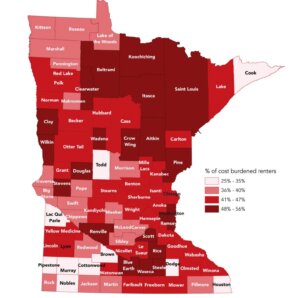 According to the U.S. Department of Housing and Urban Development (HUD), affordable housing costs the occupants no more than 30% of their income for gross housing costs, including utilities. Those who exceed this threshold are considered “cost burdened”. Sadly, the Minnesota Housing Plan’s 2022-2023 report found that 536,000 Minnesota households are cost burdened.
In the graphic shown, the Minnesota Housing Partnership’s 2021 report breaks down cost burdened renters in Minnesota by each county.
As seen in the graphic, Minnesota’s affordable housing crisis is felt in every corner of the state. Renters who qualify for housing choice vouchers, which allow them to find housing they can afford, struggle to receive one. Additionally, there is a shortage of affordable homes. The creation of homes built through project-based vouchers, which makes a specific home in a building deeply affordable, is nearly out of reach due to roadblocks created from current housing policies.
“For my two sons and I, home means consistency. It’s a place that will always be ours,” shared Jessica, a Beacon resident who has benefited from over a decade of stability in her deeply affordable and supportive home with onsite services.
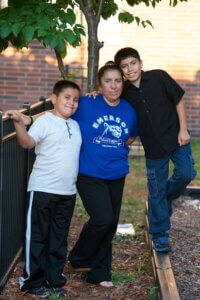 Watching her sons grow up and succeed in school, Jessica feels a sense of pride. Working alongside her case manager, she has the tools to maintain her family’s stability as they thrive in a community they love. However, Jessica knows firsthand that this kind of stability is not felt by everyone.
“I’ve worked in the cafeterias at Minneapolis Public Schools for nine years. I can tell when a student doesn’t have a stable home. They struggle,” Jessica explained. “There are bags under their eyes. They ask for extra portions…So many students have a place to call school, but not a place to call home.”
According to a survey by the Center Square – Minnesota in 2021, nearly 3,400 Minnesota families with children experience the trauma of homelessness on any given night. However, we know that number to be a conservative one-night estimate, as so many homeless families remain uncounted or unseen.
Families struggling to claim stability find themselves waiting on the all-important call that they’re one of the lucky few who will get a voucher to help pay their rent. The Housing Choice Voucher program, formerly called Section 8, is the federal government’s largest program for assisting very low-income families, the elderly, and people with a disability to afford housing. However, according to the Minnesota Housing Partnership, only one in four Minnesotans who qualify for federal housing choice vouchers ever receives one. The average wait time for a voucher is seven years.
“Getting the call that I could move in felt like winning the lottery,” exclaimed Amanda, a resident at one of Beacon’s family supportive housing developments. “My new home and the stability it offers me as a single mother has given us the green light to go for our dreams.
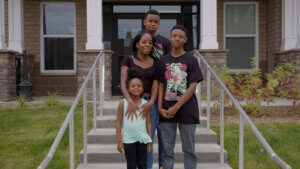 “The need for more affordable housing in communities such as the one I live in is very important because it gives single parents like me the opportunity we may have not otherwise had to raise our children in this life-changing environment.”
Beacon homes such as Audubon Crossing, Cedar View, Cranberry Ridge, and Creekside Commons give residents quality places to live. Many of the residents benefit from onsite services which help them thrive. This is the power of supportive housing: it combines an affordable place to live with supports that equip residents with skills and resources that move them forward. Creating supportive housing is only possible when project-based vouchers are available.
We know that family supportive housing is one of the most important pieces on the housing spectrum to end homelessness.
According to research done by the Wilder Foundation, family-supportive housing can break the intergenerational cycle of housing instability. 77% of individuals who experience homelessness as adults also experience homelessness during their years as children and teens.
And 36% of individuals first become homeless at or before the age of 18. Additionally, the Wilder Foundation found that at the time of reporting, 32% of those experiencing homelessness were children 17 and younger living with their parents.
The need for bold solutions for home is incredibly clear. As we work to see that all people have a home, Beacon is developing more family-supportive housing, especially in the suburbs where it is so scarce. Projects in our pipeline include Prairie Pointe in Shakopee, Vista 44 in Hopkins, Emerson Village in North Minneapolis, and Gladstone Crossing in Maplewood.
In order to advance these homes, and in order to change the landscape of home in our state, we’re also working to change underlying housing policies.
 Through our Bring it Home, Minnesota campaign, we aim to ensure that all Minnesotans who qualify for a rent voucher receives one. Our Unlock the Metro campaign calls on the Met Council to a pass project-based voucher policy that will enable the creation of more deeply affordable homes throughout the suburban metro. These key policy initiatives will lead to more resources for supportive housing.
A 2015 study from the Wilder Foundation stated that permanent supportive housing in Minnesota serves a unique and critical function in providing a pathway out of homelessness for those who face the greatest odds and the most burdensome challenges to securing safe and stable housing.
We know this is hard work with many interconnected elements. But we also know that this is essential work. It takes a collaborative to change the landscape of home. As a leading developer of affordable housing in the state, we are doing the work needed to see that all people have a home. Through transformative policy change, the creation of more homes, and an engaged collaborative, we can do it.
“Together we need to continue to raise our voices,” Maddalin asserted. “We need to live our faith values and keep pushing to help get our neighbors what they need to find affordable and stable housing.”
We have a unique opportunity to win the solutions needed to see that all people have a home and we need you to join us. Click here to make a gift to help advance our work and learn the ways you can get involved today.